I recently started seriously trying to learn Japanese very recently, but I have some background from taking Japanese language classes in college. While doing review for a vocabulary schedule, I noticed that 店員(てんいん) does not have that "n"-sound that I associate with ん. Researching it came up with topics aboit nasalization and what that kinda went over my head. So my question/s: is this kind of like a nuance of Japanese that doesn't translate hard and fast like the other hiragana? As far as I remember, this was never covered in classes and is the first time I have been exposed to this topic. Is there, like, a rule that would indicate that the pronunciation is different, or is it something that you learn as you expose yourself to more of the language and vocabulary? Would this nuance ever apply to words written in katakana considering, as far as I am aware, it's mainly used to indicate foreign/borrowed words?
This is the kind of phonetic modification that native speakers make without even realizing that they are doing it. Glossing over the linguistic phenomena involved, you can think of it as sloppy diction, which it is, at least in the sense that it disappears when people enunciate unusually clearly to make sure they are not misheard.
Unfortunatly, in this case, it was probably not the sloppy diction =p
There is at least 5 ん according to research (up to... 12? I think, in some classification)
You can found more about those in this video (around 8:44). There are english subtitles too :3
Also, I never studied those or tried to remember the rules. You don't really need too, except if you're the type that need/want to know the rule. But just being aware and listening a lot works fine too :3 Also, if you interesting in that kind of things, that video also have a "fun" things about pronounciation. For later, the guy on the left has a channel about pronounciation/phonetic, called だいじろー (but it's in japanese, so probably too hard for now)
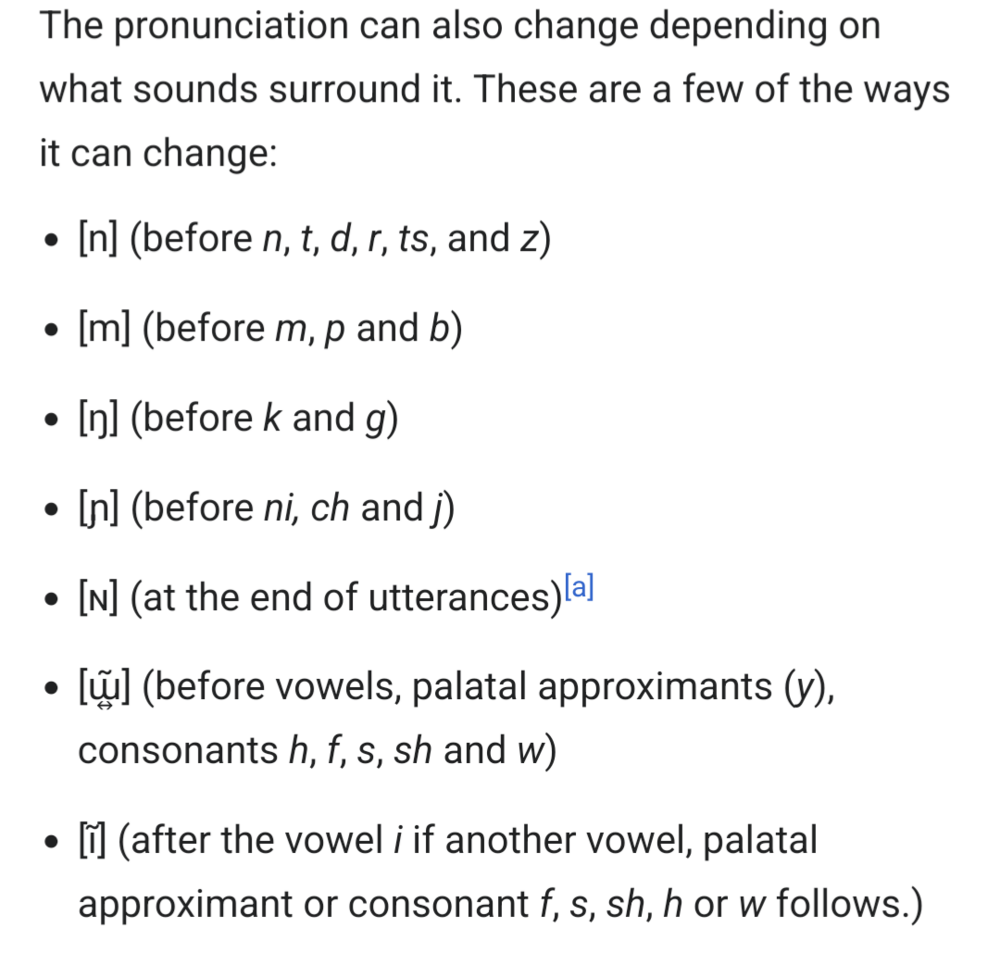
ん's pronunciation depends on the sounds surrounding it, and is often not a clear N sound like you would assume from the romaji. Very many Japanese sounds do not sound like how their romaji would be pronounced in English (like ふ), or are situationally different from their romaji pronunciation (like が), so it's important to listen to native pronunciations of words without preconceptions based on their romaji pronunciation.
The Wikipedia articles for the kana tend to explain how they're pronounced and any consistent variations in their pronunciation. From the page for ん:
If you listen with these changes in mind, you can hear that the ん in the middle of てんいん is not "missing", but it's being pronounced as a nasal vowel instead of a hard N because it's followed by い. If you don't know what a nasal vowel is, say the words "ten" and "tell" both out loud, but stop yourself right before you reach the last consonant, so you're just saying "te~" twice -- you'll hear (and feel) that the vowel sound in "ten" is different from the vowel sound in "tell", with the roof of your mouth changing the sound to prepare to lead into the N. That difference is nasalization, and you can make any vowel nasal by just pretending you're going to say an N sound after it.